Early Encounters
with Qi Gong
My early encounters with Qi Gong and Classical Yang Style Tai Chi Chuan radically changed my relationship to my reasons for training — smoothing out the consequences and imbalances of ego-driven and professionally driven striving.
I think it is time to share a bit more about my background and how I came to study Qi Gong, and to explain why I de-emphasise the concept of Qi in a class setting. I teach with some caution because students encounter physical and energetic problems associated with the practice.
I tend to introduce the notion of Qi (vital force) via a body-based sensing approach. I think the development of relaxation and an increased felt sense is an intelligent and safe approach to practice. More about that later.
I was introduced to the concept of Qi Gong initially via standing practices. The standing practice was part of a Yang Style Tai Chi Chuan class with Master Chu King Hung in 1986 in his Drummond Street School.
The instruction in standing postures provided me with a different way of being in my body. This postural training was typically called Zhan Zhuang. It was the beginning of a deep curiosity and a fascination with standing as an exercise. For me, standing initiated a reduction of unnecessary tension that was incredibly helpful in balancing the excesses of physical training. My mind became calmly focussed in a way that differed from KickBoxing, Boxing, Karate, Classical Ballet, Pilates or Yoga.
In those days, the term Qi Gong was neither heard of nor understood. Many years later, I discovered that the term Qi Gong only came into use in China in the mid-1950s during the Cultural Revolution.
Qi Gong was a new name. It described exercises previously identified as being associated with Taoism, Buddhism and Confucianism — all banned under communism. Qi Gong really took off in China after a conference in October 1959: the “First Entire China Qigong Experience Sharing and Symposium,” where it received the green light from the CCP. This event was hosted by the Communist Government with the purpose of allowing Qi Gong practitioners and doctors a chance to admit past wrongdoing and reveal their secrets for the benefit of the people.
Many master practitioners cautiously presented at the conference. Qi Gong was now becoming accepted alongside the new emerging version of acupuncture, TCM.
Around 1987 I was working as a professional dancer and a trainer of Pilates in London. I also trained privately at that time with a Wu Shu Champion from the Shanghai Institute of Physical Culture — I apologise, as his name escapes me. He did, to his credit, compete against Jet Li. An incredible athlete, built very much like a gymnast. I was introduced to him via Tai Chi Chuan friend Christine Deibel, who suggested I meet him as he was in London studying and had some interesting Qi Gong.
He explained that he had been taught Qi Gong by faculty members at the Shanghai Institute of Physical Culture who were initially reluctant to teach him, as they deemed martial artists to be hotheads. His teachers were also still afraid of persecution, and they were particularly unwilling to impart Qi Gong to athletes they thought might misuse the skill or abuse any gains in strength to hurt others. He had to keep his Qi Gong activities secret. It appeared that teachers had been punished and swiftly dismissed from the Institute when exposed for sharing their inner cultivation techniques.
What he had learned helped him calibrate his performance technique and manage injuries — something that resonated deeply with me.
I learned a few Qi Gong sets from him. One was called Long Men — he called it walking Qi Gong, though it was pretty tough, as one held low postures for long periods with no walking involved at all. The Ma Bu, or horse stance, was held very low with the thighs parallel to the ground, and I was told it should be held for a minimum of one hour and no longer than four. In a moment of characteristic ego-driven curiosity, I went all in to see what would happen — and held it for the full four hours. It was, needless to say, a one-off experience. I could barely walk for several days afterwards, and it taught me something far more valuable than any physical gain: my ego was pretty much intact and very hungry indeed. The “hardly able to walk” Qi Gong had made its point. I should add that whilst deep in the Ma Bu one was also required to work on the Microcosmic Orbit.
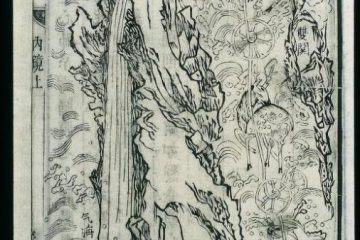
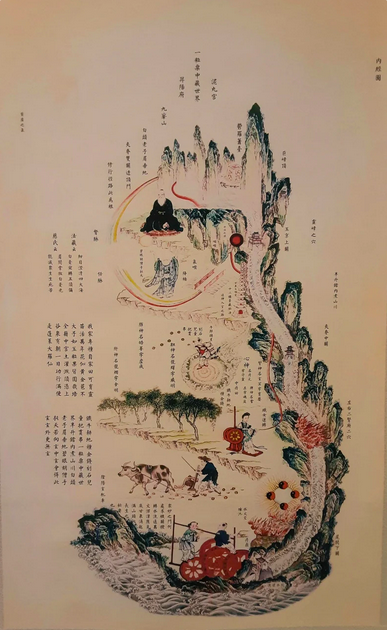
The Microcosmic Orbit element involved specific breathing and feeling combined with breath retention at key locations, working along the spine and points up to the crown of the head and back down the front of the body. I had a serious and painful reaction to this, and it is worth explaining why.
The approach to Qi Gong can have significant negative consequences if the mind and emotions are not calm — if, in other words, the nervous system is not regulated.
Attempting to cultivate Qi via breath retention and especially visualisation can exacerbate psycho-emotional issues and, rather than allowing energy and bodily fluids to circulate freely, can trap them. In my case, years of Classical Ballet had already packed my Qi very tightly. I was, in effect, trapping more Qi into an already overstuffed bag that simply could not be closed. The internal pressure went off the scale.
I ended up on the floor in agony, my testicles painfully tight and swollen as trapped energy had nowhere to go. It was a visceral and unforgettable lesson. There is an inherent danger in any Qi Gong practice that promotes what can be termed packing, holding and the closing of points — known as Bhandas in Indian Yoga — without first establishing genuine relaxation and nervous system regulation as a foundation.
I would go further and say that anyone out there in the Disney-fied, poorly trained world of popular Qi Gong who encourages the Small Circulation or Microcosmic Orbit practice through visualisation will, unwittingly but inevitably, cause harm to someone. This is not merely a personal opinion.
Peer-Reviewed Reference
Dr. H.H. Shan of the Shanghai XuHui Mental Health Center published a peer-reviewed study in the Hong Kong Journal of Psychiatry (2000) documenting an epidemiological study of 207 cases of Qi Gong deviation syndrome at the Shanghai Institute of Qi Gong Research. His findings were significant enough that mental disorders induced by Qi Gong practice were formally incorporated into the Chinese Classification of Mental Disorders (CCMD-2) as a diagnostic category as early as 1989, and subsequently recognised by the fourth edition of the Diagnostic and Statistical Manual of Mental Disorders (DSM-IV). The documented adverse effects range from physical symptoms such as pain and abnormal bodily sensations to dissociative states, paranoia and frank psychosis.
What the Chinese tradition grimly calls Zou Huo Ru Mo (走火入魔) — “fire running wild, the devil enters” — is not folklore. It is a clinically documented reality. Thankfully, I was already aware of the phenomena of Qi Neurosis, Qi Psychosis and Qi Disturbances, and I had been warned of such reactions and knew the antidote. Not everyone is so fortunate.
The final set I learned was a three Dantian activation, very much a variation of the open and close of the Hun Yuan System. The basics of Qi Gong are quite generic; what differs is the ability of the performer. Attitude, mindset and dedication bring results — and a set is best transmitted by a decent human being, not an egoist.
That was my early introduction to Qi Gong. Although my primary practice during the mid to late 1980s was Tai Chi Chuan, Qi Gong and especially standing postures served as a vital antidote to overt and excessive strength training, ego striving and exercise neurosis.
Some years later I held a weekend workshop at my studio in London, a place where I taught for twenty-six years until 2019. At one point a participant remarked that I had not mentioned Qi at all throughout the session. I took the opportunity to make something clear: any discursive thought about Qi is not your Qi — that is simply the mind at work. Your Qi will move, and can be stored and contained, when you are relaxed, and when your intention is clear and unobstructed by thinking. In other words: relax, and be calm. That is the practice.
A common and significant fault among students is to fantasise about vital energy rather than feel it directly. Nowhere is this more apparent than in certain corners of the internal martial arts world, where one encounters the persistent delusion of throwing others across the room without even touching them. This is a serious mistake — a substitution of imagination for genuine cultivation, and one that ultimately obstructs the very thing it claims to pursue.
Direct perception of one’s own Qi is neither imagination nor visualisation. It is in the stillness that lies beyond both that Qi, as a living flow and resonance, may at last be perceived.
To arrive at it, one must develop genuine calm and an egoless state. You cannot think your way there. You can only become quiet enough to feel it.
CRC · December 2021